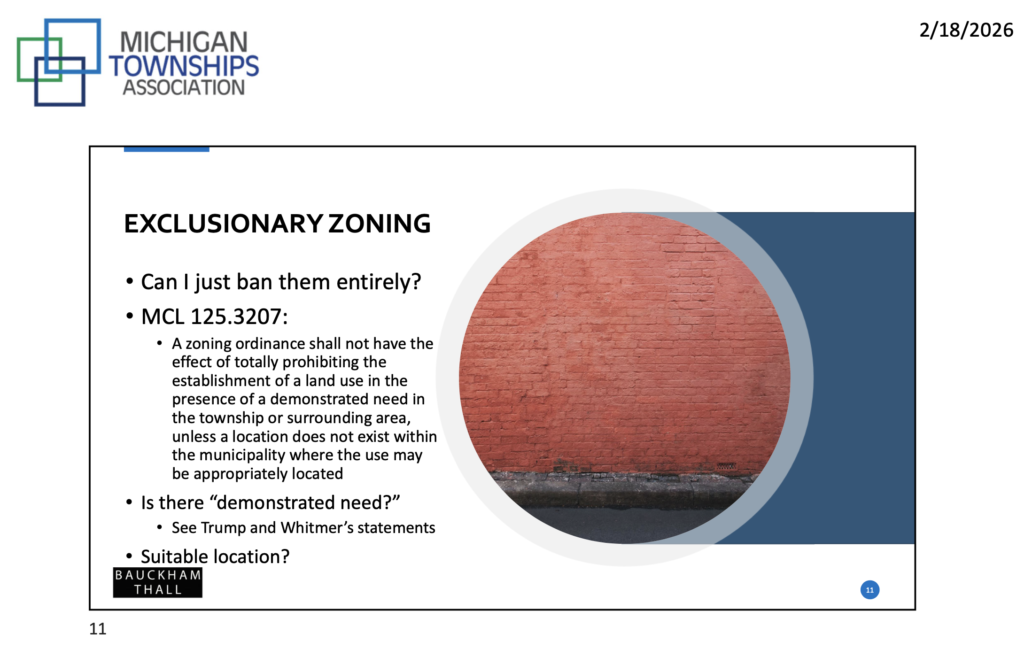
Many credible sources are misstating what the Michigan Zoning Enabling Act actually says about “exclusionary zoning.” Section MCL 125.3207 states:
“A zoning ordinance or zoning decision shall not have the effect of totally prohibiting the establishment of a land use within a local unit of government in the presence of a demonstrated need for that land use within either that local unit of government or the surrounding area within the state, unless a location within the local unit of government does not exist where the use may be appropriately located or the use is unlawful.”
If there is no demonstrated public need for that land use locally or in the surrounding area, then it’s not “exclusionary zoning” to exclude the use. Likewise if there is no appropriate place, or if the use is unlawful.
In Michigan, municipalities have “Euclidian zoning ordinance[s], meaning that the zoning ordinance contains certain zoning districts and allows certain uses in each zone. A key aspect of Euclidean zoning is that if a principal use is not expressly permitted in a zoning district, it is prohibited.” (See the Michigan Supreme Court case, Jostock v Mayfield Township).
Attorney Ellis Boal, co-counsel representing a Saline Township resident suing to intervene in the Consent Judgement between the township and data center developers, has a working paper on Exclusionary Zoning that we encourage all Michigan residents fighting data centers to read.
Strangely, the Michigan Townships Association, which always advocates and lobbies for local zoning control, said in its data center webinar to townships about whether there is a demonstrated need for a data center: “See Trump and Whitmer’s statements.” (See slide). Since when does the MTA think that the president and governor dictate what local land use needs are for Michigan communities when it comes to planning and zoning?